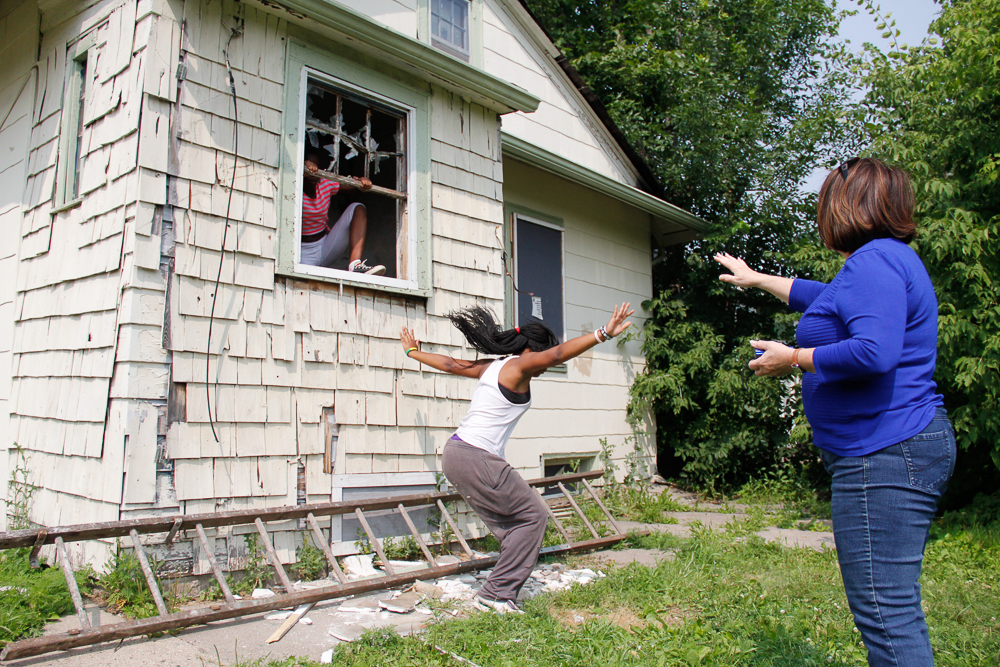
A shot from my work-in-progress about housing discrimination in the aftermath of the foreclosure crisis.
I’m only a few weeks away from completing my master’s degree at Medill. My thesis story — what at Medill we call a “capstone” — will deal with housing discrimination in the wake of the foreclosure crisis. That’s about all I can say for now, but stay tuned for more in just a few weeks.
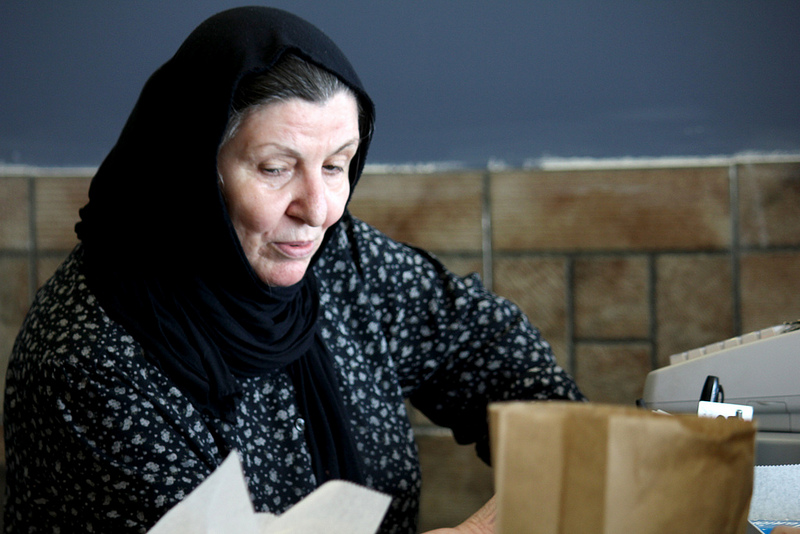
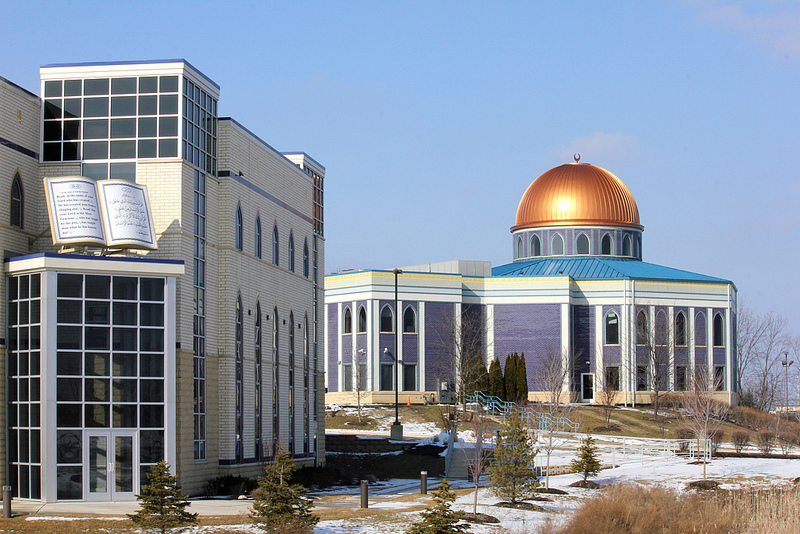
Laila Maali owns Grape Vine in Orland Park, Ill. She’s part of the region’s large Palestinian diaspora.Grape Vine stocks middle eastern delicacies like butter ghee, red lentils and pickled turnips.The Prayer Center mosque in Orland Park was built in 2004 to accomodate the region’s growing Muslim community.
Chicagoans are fond of saying that there are more Poles here than anywhere outside of Poland. But did you know there are more people of Palestinian descent living in Chicago’s southwest suburbs than in any other city in America? I didn’t either, until I went to Orland Park last week.
Orland Park, Ill. is a town of about 56,000 sandwiched between routes 55 and 57. It has a big mall, and a lot of smaller strip malls, many new housing developments and a ton of beautiful, wooded forest preserve land. And, along with neighboring suburbs like Bridgeview and Oak Lawn, it has a sizable Arab American population.
For the past few weeks, my boss has been sending a different web producer and reporter from the broadcast side of things out to the suburbs to explore, discover, report etc. We’re supposed to go in not knowing much, but then we’re supposed to find a quick-turnaround story and report it in one day. Last week it was my turn; I went out with Michael Puente, who normally covers Northwest Indiana for us — and is super awesome.
Michael actually worked at the Orland Square Mall — in a formalwear store! — when he was in his early 20s. But I knew nothing about Orland Park. I had heard that the southwest side of Chicago around Marquette Park used to be a landing pad for Arab immigrants (I learned this from the Arab American Action Network after I did a story with them in 2010 for my series Dear Chicago), but I had no real concept of what that community was like. I certainly had never heard that Chicago was home to the country’s largest population of Palestinian immigrants.
But when Michael and I went to Grape Vine, a small middle eastern bakery and grocery, we met the owner, Laila Maali, as well as her landlord and her friend/handyman. Her landlord, Edward Hassan, told us that all three of them came from the same village near Ramallah and that there were more people from their village living in Chicago now than there were left living in the village!
That claim obviously caught my ear; I knew when he said that there was probably a story there, one that I had not heard before and one that surprised me very much.
Hassan’s claim turned out to be exaggerated, but true in its nature; his home village, Beitunia, has traditionally been the largest feeder village of Palestinian immigrants to Chicago.
Hooked yet? I hope so. You can read the full story here. And check out my appearance with Michael Puente on the Afternoon Shift here:
Coincidentally, the story I was working on last week tied into another project I’ve been working on — the Curious City podcast. I took over podcasting for WBEZ recently, and I’ve started working more closely with Jenn Brandel by helping edit the podcast every week.
Last week’s episode featured a story reported by Odette Yousef, our North Side bureau reporter. It deals with the resettlement of refugees on Chicago’s North Side, and answers the question: What is the most diverse neighborhood in the city?
The part that really caught my ear was when Curious City/Bureaus editor (and my pal) Shawn Allee connected the dots between U.S. immigration policy and the physical makeup of the city. When our immigration policy allowed more people from one country to come and settle together, you got neighborhoods like Argyle Street, home to Chicago’s Vietnamese community. But when we let only fewer numbers of people come to the U.S. it was harder for them to make the kind of neighborhood impact that’s easy to see from other ethnic communities. (I’m probably bastardizing Shawn’s words a little bit, but luckily you can listen to the audio above.) I had never made that connection before, and I found it really interesting.
Palestinians immigrants living here are not refugees in that the U.S. government does not recognize them as such. But they and Chicago’s other Arab immigrants have clearly left their mark on the region, whether it’s in the form of the new mosque in Orland Park or the businesses along Lawrence and Kedzie on the Northwest Side of Chicago. Next though, I want to go to Bridgeview, Ill. It has the oldest and most established Arab American community in the Chicago area, and the oldest mosque. I think it is also more densely populated and urban, as it has its center between 79th and 87th along Harlem. (How that is not a part of Chicago I don’t know.) The expert I interviewed for my story, Louise Cainkar of Marquette University, said she once counted over 100 Arab-owned businesses in that one mile stretch of street!
Me and Paul Tough in WBEZ’s Green Room before our appearance on the Afternoon Shift with Steve Edwards. (Photo by Bill Healy)
Reporter Paul Tough has a new book out about education. How Children Succeed builds on the work he’s done for the New York Times Magazine and an earlier book about Geoffrey Canada’s Harlem Children’s Zone. He was a guest on the Afternoon Shift with Steve Edwards in September, and I was invited on to discuss my reporting at Chicago Jesuit Academy. Take a listen to my conversation with Steve, and hear Paul’s portion of the conversation here.
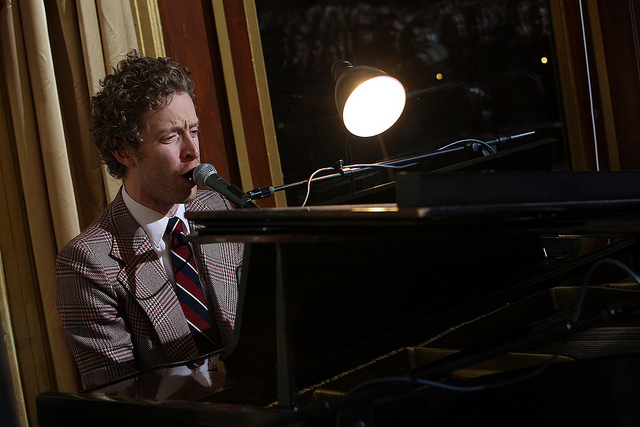
Three participants read embarrassing stories about their lives. Then, host Brian Costello interviews them for a few minutes. By that time, pianist Abraham Levitan has composed a song based on their story, in a musical genre determined by spinning a musical Wheel of Fortune. (When I went, options included “Good Aerosmith,” “Bad Aerosmith,” and “Muppets.”)
Let me tell you – Abraham Levitan makes this show. He is so talented, so quick and so funny! Seeing him perform in Shame That Tune, one feels the pleasure of recognition, watching him weave little details from each story into the song; delight, in his ability to mimic almost any musical style; and amazement that he has done it all SO FAST.
So imagine my delight and amazement when I learned recently that, unbeknownst to me, I had been Shame That Tuned! Well, sort of.
I’m embarrassed I didn’t know this sooner, but here’s what I learned: The lovely ladies of the Third Coast International Audio Festival’s program Re:Sound will, on occasion, commission Abraham to write and record a song based on the radio pieces they present in that week’s episode. And they had commissioned Abraham to write a song for their episode called The Lost Show, which features my story Ghosts of Gary.
I heard a rebroadcast of the show when I was driving home from somewhere a few weeks ago. It’s always fun to turn on the radio and hear your own story pop up (never gets old for me, actually) but I was totally surprised and enthralled when I heard Abraham’s song.
Along with my story about the abandoned Palace Movie Theater in Gary, Ind., the show features stories about Hopi teenagers struggling not to lose their language; an episode of Nate DiMeo’s excellent podcast The Memory Palace about two sisters who discover they can speak to the dead, and a story about a nursing home for actors. From that Abraham wrote a song, which to my ears sounds like a waltz, called We Were Beautiful When We Were Young:
May you die in Act five, Scene three May your kids learn the native tongue My sister and me haunt the streets of Gary We were beautiful when we were young
Me and my sister, we talk to the dead We find out exactly how Sam Beckett read We break into the Palace Where performing live It’s the ghosts of the Jackson Five
When our dead brothers come back we’ll all form a line If we can speak their language they’ll let us off fine But just when they’ll appear, don’t nobody know It’s like waiting for Godot
May you die in Act five, Scene three May your kids learn the native tongue My sister and me haunt the streets of Gary We were beautiful when we were young
I fell asleep in the lobby And didn’t get home until four Dance my dreams with Dillinger’s ghost Man, my mother was so, oh…
So I died in Act three So my kids never learned my tongue My sister and me haunt the streets of Gary We were beautiful when we were young We were beautiful when we were young
The audio is above. Please listen to it! Aside from the novelty factor, it’s really very haunting and beautiful, with Abraham’s plaintive vocals and the resonant sounds of the organ. I also love all of his little touches, like the eerie “ABC…1-2-3…” after the verse about the ghosts of the Jackson Five.
Recording on the deck of Excalibur. Photo by Karen Hoffman.
6:20
At the start of the Race to Mackinac I was several miles out from the shoreline, photographing competitors from the press boat. Occasionally a missive would come across the radio from the race committee.
“Argo this is Breaker, we see 19 boats.”
“Copy that Argo, we also see 19 boats.”
Once all the starters from that category had been accounted for, the race committee would sound the starting cannon and they would be off, colorful spinnakers raised to the wind. The next line of boats would advance from the starting area.
But occasionally a boat would not be accounted for, and the race committee would radio back and forth trying to find them. In the middle of the afternoon we heard this on the radio:
“Where’s WingNuts?”
If you’ve been following the news or heard my recent story on the subject, you probably know that WingNuts is a 35 ft. sailboat out of Saginaw, Mich., that would tragically and shockingly lose its skipper another crewmember before the weekend was out.
The Chicago Yacht Club’s Dockmaster, Ryan McPheeters, who was driving the press boat, smiled and shook his head when he heard the race committee was looking for WingNuts. “That boat is wacky,” he told me.
“What do you mean?”
He reiterated. “That boat is wacky and her crew is wacky.”
He pointed out the sides of the hull that swooped out at the deck to make what looked like wings. This was apparently somewhat unusual. I got the impression from the rest of the conversation that when he called the crew wacky he meant they were fun loving and well-liked.
When I came into work Monday morning, preparing to finish what was supposed to be a light-hearted multimedia story about the race, and heard that two competitors had died, I was really stunned.
I remember walking over to my co-worker’s desk in a daze.
“They were from Wingnuts…?”
I couldn’t believe that people had died. I couldn’t believe I had seen them. I was worried for the other people I knew in the race, and I knew I couldn’t complete the story I had originally intended to produce.
Going through my tape was like listening for ghosts. I found moments I had forgotten about: the crew of Excalibur reading their Sail Flow charts and pointing out a storm that was likely to hit at 1 a.m. Sunday night; running into Sociable on our way to the start and hearing their crew joke around with Excalibur’s about how they were heading the wrong way, as they went to drop me off at Monroe Harbor.
It was very eerie.
Since I’ve finished the story I’ve gotten some interesting feedback from people in the sailing community. In my reporting, I heard people raise questions about the role of the Coast Guard in the search and rescue operation. Later I heard from a sailor who is also part of the Beneteau fleet that counts both Sociable and Excalibur in its ranks. “Spending the night monitoring the VHF transmissions from Sociable was one of the worst experiences of my life,” he told me. He also said this:
“I don’t know if the expectation of rescue is something more concentrated on the [Great] Lakes or if it comes from inexperience, but I started hearing that around from some sailors who were newer to the sport and none had left the [Great] Lakes. On the Pacific, on shorter races than the Mac, we are regularly out of rescue range for days on end…
Anyhow, the lack of divers certainly didn’t make any difference in the outcome. No chopper could have launched in that storm and it would still take 45 min. to an hour to reach them. After that long unconscious and under water, a diver can’t help anyway. It’s still terrible, but there is no reason to blame lack of rescue. Only to praise the efforts of Sociable and the others who responded.”
This came from a WBEZ listener who heard the story when it aired on 848:
“The USCGC Mackinaw does indeed follow the race, but is there as a courtesy escort. The thought of one boat being expected to ensure the safety of over 300 boats, of different speeds, scattered throughout the lake, is ridiculous, and it’s disturbing to hear that a sailor expected this. Sailing is a challenging sport, and most boaters realize that the responsibility for the their safety ultimately lies in their own hands.
Counting on the Coast Guard to behave like a safety net is a dangerous attitude to bring on the water. Sailing on our Great Lakes is an incredibly rewarding pastime, but the challenges that make it so come with risks that we sailors must accept and take responsibility for.”
I plan to stay on this story, although I don’t relish the next step: talking to the Charlevoix County Sheriff’s office when they get back the coroner’s report some time in the next few weeks.
Sugar Cream Pie by Sarah Strierch.Boston Cream Pie may have found its way into our shared dessert lexicon, but what about Hoosier Cream pie? Or Indiana Persimmon Pie? News of these regional treats had never reached me before I heard this lecture by pastry chef Paula Haney. Haney has cultivated a devoted following in Chicago with her perfect pies – lemon chess; pork, sage and apple; lattice topped blueberry – since founding Hoosier Mama Pie Company in 2005. Now, Haney unveils the secret history of Indiana pies, from the Amish inspired “desperation pies” of her Indianapolis youth, to pies made from exotic native fruits like the wild American persimmon, paw paw, and custard apple.
In this excerpt, Haney goes into the delicious history the sugar cream or Hoosier Cream pie, Indiana’s official state pie as of 2009. (According to Haney, at the time of this lecture there was heated debate between the sugar cream camp and the persimmon custard camp.)
3:58
If you want a taste of Indiana’s official pie, Hoosier Mama carries it at their Chicago shop. Or, you can go on a pie pilgrimage and follow the Hoosier Pie Trail! Better yet, make your own, using a recipe like this one from Turkey Creek Lane.
Click here to hear the rest of Haney’s talk, including a section about the South Side’s endangered pie species, the bean pie. Sponsored by Chicago Culinary Historians, and recorded by Chicago Amplified, a program of Chicago Public Media.
Soul and gospel legend Mavis Staples has an album in the works with another Chicago home town hero, Wilco’s Jeff Tweedy. The two performed together at Lollapalooza; Staples later stopped by the station for a surprising duet with WBEZ’s Rob Wildeboer. (Did anyone else know he could tickle the ivories like that?!)
Staples describes how in her youth there was an uneasy relationship between gospel and R & B; gospel artists who “crossed over” to singing the blues for a more secular, mainstream audience often felt the wrath of their churchgoing brethren. (A subject explored in depth in another great Amplified event, Sinners in the Choir: The Black Church and the Devil’s Music.) Here, Staples describes her introduction to secular music during the summers she spent with family in Greenwood, Mississippi. It seduced her, but she never abandoned her gospel roots.
“O Day” by Bessie Jones, from “The Alan Lomax Collection: Southern Journey, Vol. 1 – Voices from the American South.”
“Since I Fell For You” by Nina Simone, from “The Soul of Nina Simone.”
Editor’s Note: The version of “Since I Fell For You” that Mavis Staples likely heard as a child in Mississippi was the 1947 version released by Annie Laurie with Paul Gayten and His Trio, which according to Wikipedia eventually reached #3 on the “Race Records” charts and #20 on the pop charts. I used the Nina Simone version from 1967 because I liked how it matched the cadence of Staples’ rendition during her talk. You can find the Annie Laurie version on iTunes, although I don’t think I can post it here in its entirety because of copyright issues.
Azhar Usman jokes that he looks like “that guy from LOST. Not the Indian one, the fat one!” The Chicago comedian uses humor to poke fun at racial stereotypes, referencing his own life as the child of Muslim immigrants growing up in mostly Jewish Skokie.
Usman recently did an extended set in front of an intimate audience at Chicago’s Th!nk Art Salon as part of their ongoing War & Peace exhibit. Usman performs regularly alongside a Rabbi/comedian in a show they’ve dubbed the Laugh in Peace Tour.
The evening took a surprisingly deep and personal turn when Usman shared a story about learning to parent four young sons inquisitive beyond their age.
Ah Austin. The coolest city in Texas. Now even cooler because they keep licensing my radio pieces for broadcast. Thanks, KUT!! My piece on Malort aired last night on their late night documentary show, O’Dark 30. Now I’ve received word that Austinites can hear Ghosts of Gary sometime soon. Details when I get them.
Also, I looked this morning and saw that my video piece on the Fireside has been viewed over 1600 times since Friday morning. WAT. This has been a great week.
I just got word that the Third Coast International Audio Festival, audio doc powerhouse extraordinaire, wants to license one of my pieces for their show Re:Sound! I am really really happy about this. The Third Coast Festival is pretty directly responsible for me living in Chicago, having professional connections in radio, and loving the medium of audio documentary as much as I do. They are amazing curators who bring together outstanding content from all over the world, and I am extremely flattered to have my work included in their broadcast.
They’ve licensed Ghosts of Gary for a broadcast on the theme of “loss.” It’s scheduled to air July 3rd. See their show page for details on how to hear the show, or to subscribe to their excellent podcast. Whee!





 Robin Amer
You must be logged in to post a comment.