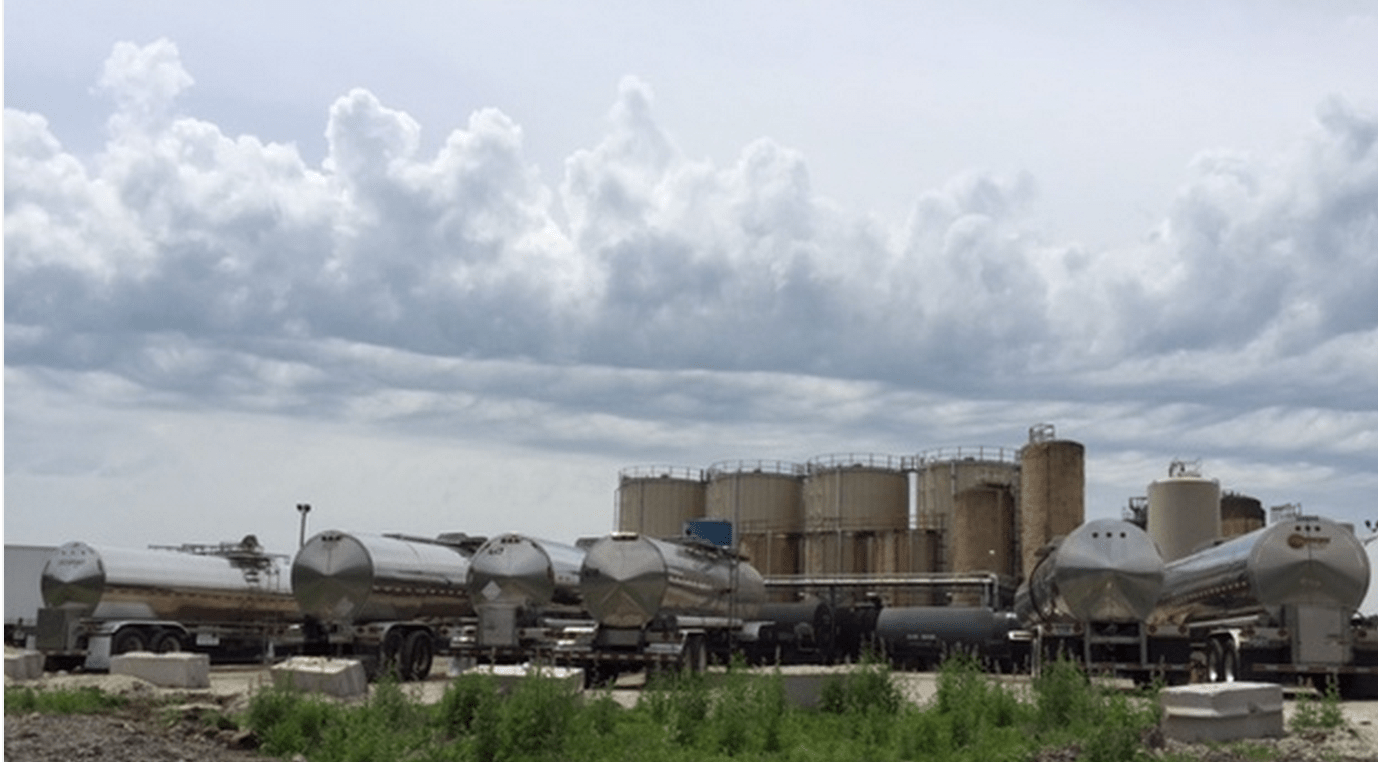
Agri-Fine Corp. produces a component of animal feed at its Southeast Side facility. The state says odors from the factory are making people ill. (Photo by Robin Amer)
I’ve spent much of this summer reporting on Chicago’s Southeast Side for DNAinfo Chicago. The so-called “Forgotten 10th Ward” is home to much of what’s left of the city’s heavy industry, so many of the stories I’ve reported have focused on conflicts between industry and the environment.
Case in point: Agri-Fine Corp. is a family-owned business that manufacturers a component in animal feed. But the plant’s neighbors and the state allege that the company has been emitting noxious fumes from its facility. Here’s a round-up of stories I’ve reported on Agri-Fine. (I’ll update the list with any future stories, too.)
A worker takes a break from his shift at Finkl Steel. Photographed in 2013. (Robin Amer)
I have a new story out in Belt Magazine today. Belt tackles the future of so-called “Rust Belt” cities from Pittsburgh to Detroit to Cleveland to Chicago. My story is about the future of the Finkl Steel site, which up until last year was home to Chicago’s oldest steel maker. The site is enormous — 28 acres of prime real estate in the heart of the city. My piece explores how it managed to stay industrial for so long despite rising real estate prices, and what might happen now that the steelmaker has vacated the premises.
Update Jan. 30:
I was a guest on WBEZ’s Afternoon Shift earlier this week talking about the story. Here’s the audio, in case you missed it.
Graham Thompson, owner of Optimo Hat Co., ordered a custom concrete countertop for his shop in the Monadnock Building. Concrete floors, countertops and home wares are popping up in chic homes and shops all over town. (Photo by Robin Amer)
Once maligned as ugly and utilitarian — or worse, associated with out-of-vogue architectural Brutalism — concrete is back. The bulk stuff is popular again with hip builders, architects and craftsmen, and being put to use in upscale residential and commercial interiors all over Chicago.
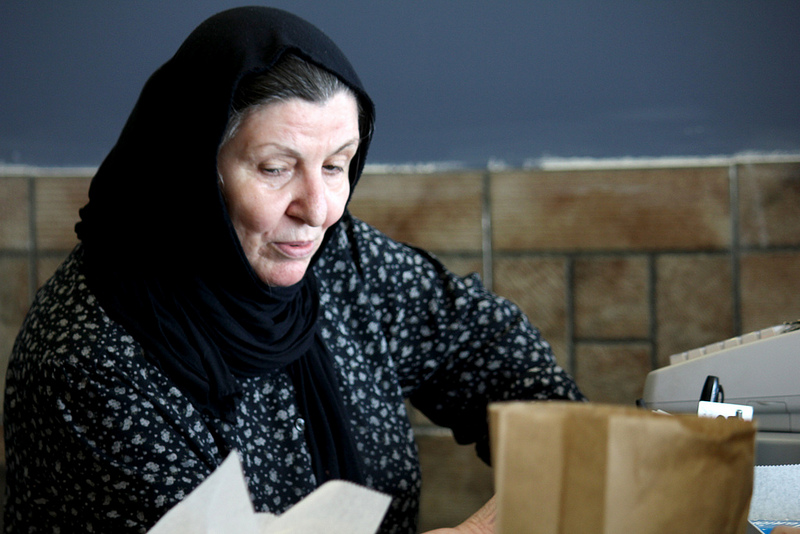
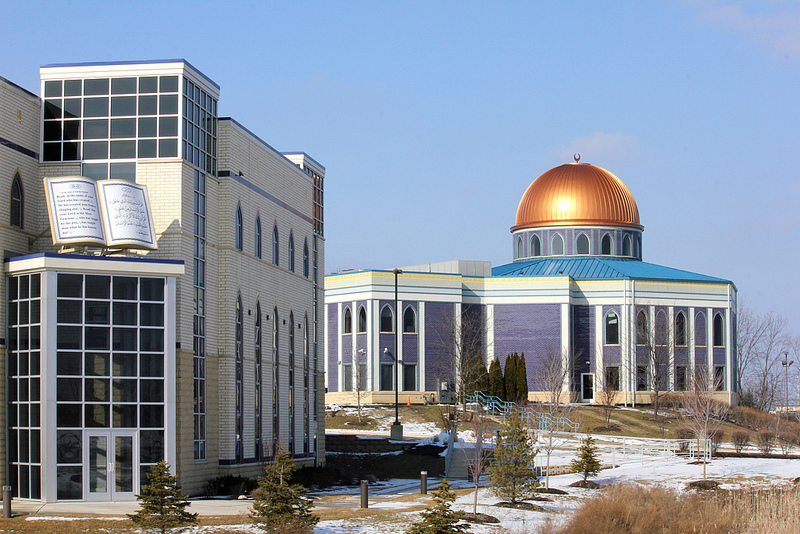
Laila Maali owns Grape Vine in Orland Park, Ill. She’s part of the region’s large Palestinian diaspora.Grape Vine stocks middle eastern delicacies like butter ghee, red lentils and pickled turnips.The Prayer Center mosque in Orland Park was built in 2004 to accomodate the region’s growing Muslim community.
Chicagoans are fond of saying that there are more Poles here than anywhere outside of Poland. But did you know there are more people of Palestinian descent living in Chicago’s southwest suburbs than in any other city in America? I didn’t either, until I went to Orland Park last week.
Orland Park, Ill. is a town of about 56,000 sandwiched between routes 55 and 57. It has a big mall, and a lot of smaller strip malls, many new housing developments and a ton of beautiful, wooded forest preserve land. And, along with neighboring suburbs like Bridgeview and Oak Lawn, it has a sizable Arab American population.
For the past few weeks, my boss has been sending a different web producer and reporter from the broadcast side of things out to the suburbs to explore, discover, report etc. We’re supposed to go in not knowing much, but then we’re supposed to find a quick-turnaround story and report it in one day. Last week it was my turn; I went out with Michael Puente, who normally covers Northwest Indiana for us — and is super awesome.
Michael actually worked at the Orland Square Mall — in a formalwear store! — when he was in his early 20s. But I knew nothing about Orland Park. I had heard that the southwest side of Chicago around Marquette Park used to be a landing pad for Arab immigrants (I learned this from the Arab American Action Network after I did a story with them in 2010 for my series Dear Chicago), but I had no real concept of what that community was like. I certainly had never heard that Chicago was home to the country’s largest population of Palestinian immigrants.
But when Michael and I went to Grape Vine, a small middle eastern bakery and grocery, we met the owner, Laila Maali, as well as her landlord and her friend/handyman. Her landlord, Edward Hassan, told us that all three of them came from the same village near Ramallah and that there were more people from their village living in Chicago now than there were left living in the village!
That claim obviously caught my ear; I knew when he said that there was probably a story there, one that I had not heard before and one that surprised me very much.
Hassan’s claim turned out to be exaggerated, but true in its nature; his home village, Beitunia, has traditionally been the largest feeder village of Palestinian immigrants to Chicago.
Hooked yet? I hope so. You can read the full story here. And check out my appearance with Michael Puente on the Afternoon Shift here:
Coincidentally, the story I was working on last week tied into another project I’ve been working on — the Curious City podcast. I took over podcasting for WBEZ recently, and I’ve started working more closely with Jenn Brandel by helping edit the podcast every week.
Last week’s episode featured a story reported by Odette Yousef, our North Side bureau reporter. It deals with the resettlement of refugees on Chicago’s North Side, and answers the question: What is the most diverse neighborhood in the city?
The part that really caught my ear was when Curious City/Bureaus editor (and my pal) Shawn Allee connected the dots between U.S. immigration policy and the physical makeup of the city. When our immigration policy allowed more people from one country to come and settle together, you got neighborhoods like Argyle Street, home to Chicago’s Vietnamese community. But when we let only fewer numbers of people come to the U.S. it was harder for them to make the kind of neighborhood impact that’s easy to see from other ethnic communities. (I’m probably bastardizing Shawn’s words a little bit, but luckily you can listen to the audio above.) I had never made that connection before, and I found it really interesting.
Palestinians immigrants living here are not refugees in that the U.S. government does not recognize them as such. But they and Chicago’s other Arab immigrants have clearly left their mark on the region, whether it’s in the form of the new mosque in Orland Park or the businesses along Lawrence and Kedzie on the Northwest Side of Chicago. Next though, I want to go to Bridgeview, Ill. It has the oldest and most established Arab American community in the Chicago area, and the oldest mosque. I think it is also more densely populated and urban, as it has its center between 79th and 87th along Harlem. (How that is not a part of Chicago I don’t know.) The expert I interviewed for my story, Louise Cainkar of Marquette University, said she once counted over 100 Arab-owned businesses in that one mile stretch of street!
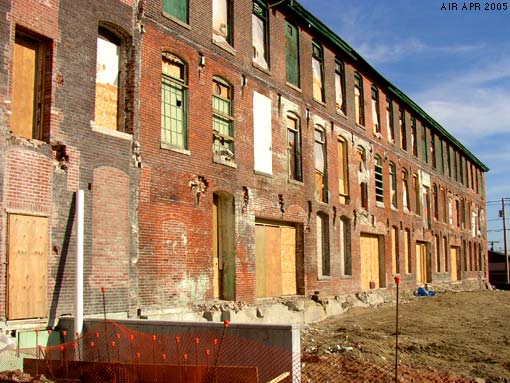
The Rau Fastner building before and after redevelopment. Photos by Teresa Mastrorilli courtesy of AIR.
WBEZ is embarking on a new series that I’m very excited about. They’re teaming up with other Midwest stations and the CPB to create a reporting initiative focused on the region’s economy. Specifically on its transformation from an economy that is “fundamentally industrial based” to one that can only be described as “post-manufacturing.”
Reading about this new project reminded me of similar reporting I have done on the post-industrial economy of southern New England. When I was in college I spent two and half years chronicling Providence’s fraught transformation from industrial powerhouse to post-industrial dead zone to supposed arts Mecca. The initial result was the documentary Reconstructing Providence.
In addition, between 2004 and 2005 I wrote several features pieces for the Providence Phoenix (their equivalent of the Chicago Reader) exploring “the new fight for Providence’s mills.”
Here are the pieces I wrote during that time, all edited by the excellent Ian Donnis.
City Watch Conley touts a face lift for Allens Avenue waterfront
(Editor’s Note: Six years later I’m cringing at all the confusing multi-clause sentences in these pieces. Ayee! How did Ian let me get away with that??)




 Robin Amer
You must be logged in to post a comment.