When I was in high school I took painting classes in an abandoned amusement park. In the ’50s there had been bumper cars, roller coasters, a Ferris wheel and a merry-go-round. By the time I got there in the late ’90s the park was empty and rusted. But artists built grass-topped yurts scattered around the park, from which they offered pottery classes and photography. There was a children’s puppet theater. An old barn was converted into a painting studio.
I remember walking around the empty park one day in the fall, when the ground was damp and the leaves were changing, listening to a particularly moody mix tape on my walkman. The feeling it gave me to be in this place was a kind of melancholy mixed with equal measures of deep satisfaction and rootedness. The earthy smell of the leaves, the squish of the ground, the mottled rust of the swing sets, the crackling of the music playing through my Walkman — this is my first and strongest memory of an overwhelming sense of place.
I have been trying to conjure this kind of feeling and this sense of place in my work ever since. In college I similarly spent my time biking around the abandoned mills of Providence, admiring ghost signs peeling off brick walls and the glitter of broken glass on the sidewalk. I could not quite articulate why I was so drawn to these places, but they appeared in my work again and again.
It took another 10 years or so before I figured out what was going on. During that time I became a reporter, and in most ways, an adult. I read Neil Smith, Mike Davis and Stuart Dybek. I learned what ruin porn was and I knew enough to know that wasn’t what I liked about these places. That wasn’t what my work was about.
I was drawn to were sites of crisis. Something dramatic and devastating had happened here, something that started with a massive investment of human and literal capital, and ended with that capital being suddenly and devastatingly withdrawn. These places were the beginning and the end of a story. I was drawn to them because I desperately wanted to know: What happened here?
This question has driven my work as an investigative reporter and documentary maker for more than a decade. It’s also the impetus behind my new project, The City.
The City is a podcast I will pilot this fall with WNYC, the public radio station best known for producing shows like Radiolab and On the Media. Producing this pilot is the prize I get for winning WNYC’s Podcast Accelerator (along with producers Kathy Tu and Tobin Low, who also got the green light to pilot a separate show called Gaydio).
I’ll have a lot more to say in the coming weeks and months about what this show is and how it will come together. But here’s a synopsis, based on what I pitched to WNYC:
Each season of The City will be a dive deep into one American metropolis. We’ll approach each season of the podcast like a six to 10 episode documentary mini-series, following one cast of characters and investigating one story that unfolds chapter by chapter.
Podcasts like Serial and Startup paved the way for this approach. But I was also inspired by documentary TV shows like The Jinx, Brick City and David Simon’s entire oeuvre.
Think of it this way: If The Wire, Treme or Show Me a Hero were a podcast and all the stories were true, this is what you’d get. Complicated, morally ambiguous characters. Nuanced storytelling. An inside look at the inner workings of a city. A deep, immersive sense of place. All the drama you’d want from premium cable, and all the hard-hitting honesty you’d want from public radio.
Just as The Wire went deep into the drug wars in Baltimore, Season 1 of The City would dive into the environmental battles raging on Chicago’s Southeast Side. This forgotten corner of Chicago is closer to the steel mills of Gary than the corridors of power in the Loop. It has what’s left of Chicago’s factories – but also its landfills and toxic waste dumps. There are lives at stake here, but livelihoods, too.
Logistically, it makes sense for us to start in Chicago for the pilot. It’s my home base and I’ve been reporting on this set of issues for the past six months. But with this model, we hope to explore a different city every season—maybe even partner with a different public radio member station every season. That means in future cities we could go anywhere: Miami, Detroit, D.C., Newark. Anywhere where there’s a compelling story to be told. Anywhere that makes us want to know: What happened here?
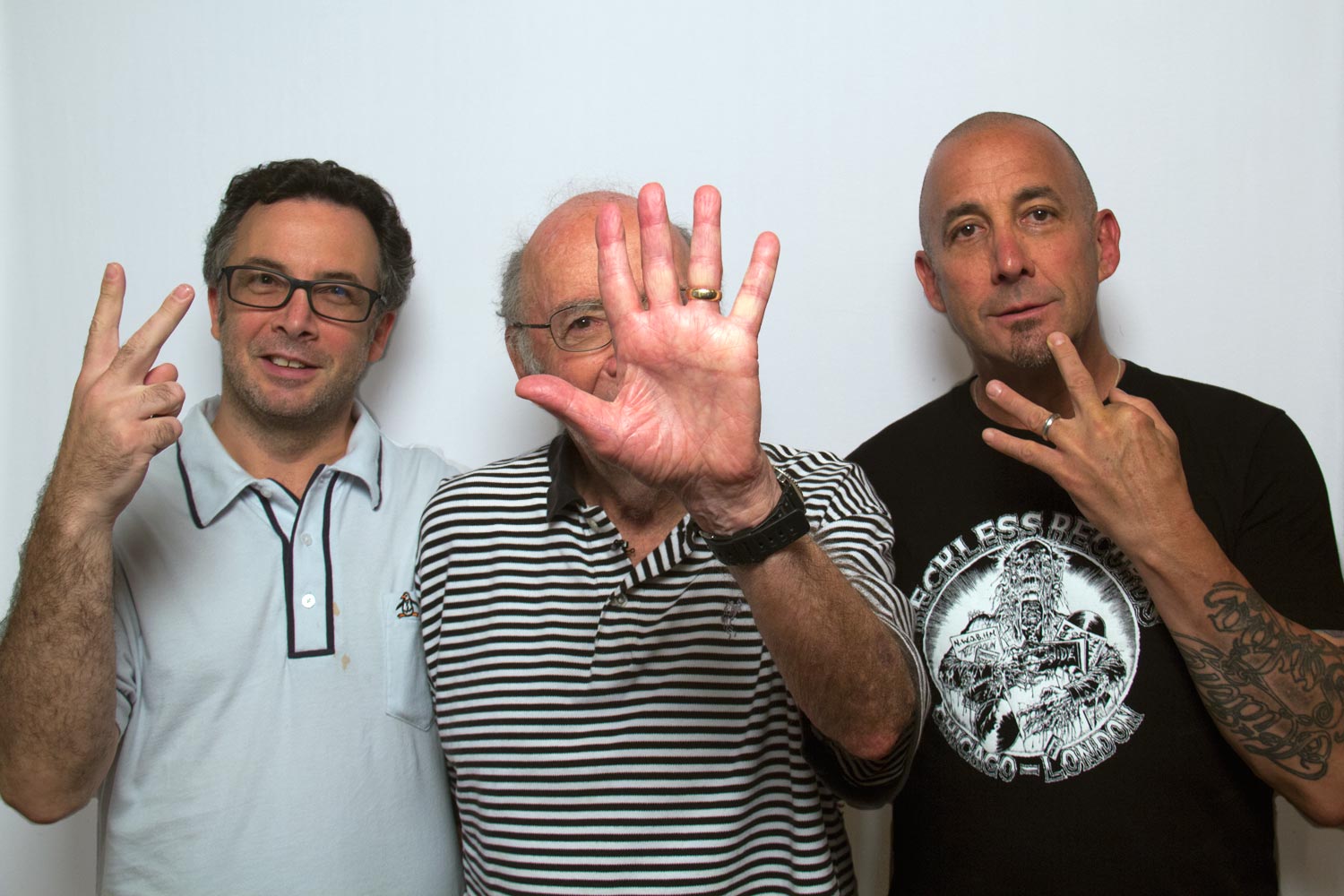
Danny, Sonny and Marty Venit all worked as traders at the Chicago Mercantile Exchange. (Photo by Andrew Gill)
For more than 160 years, traders in colorful blazers crowded into pits at the Chicago Mercantile Exchange, shouting orders for commodities like corn, cattle and pork bellies.
But with the rise of electronic trading, the futures pits have shrunk to just one percent of overall trading volume, according to the CME Group.
The company, which merged with the Chicago Board of Trade in 2007, closed all but one of its futures pits in July. Some say it’s only a matter of time before “open outcry” trading disappears for good.
To mark the occasion, photographer Andrew Gill and I produced a series of portraits on current and former traders for WBEZ.
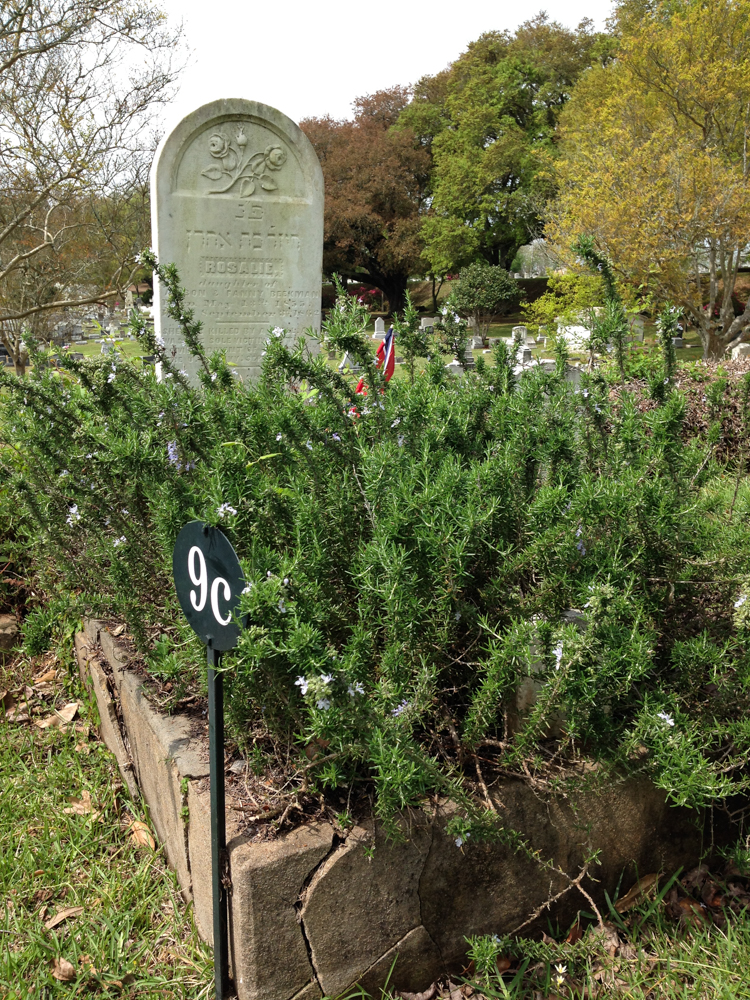
There has been a Jewish community in Natchez, Mississippi for 175 years—and my family has been part of it for 160 of them. But now the number of Jews in Natchez has dwindled to only a handful. I went home to Natchez to explore what traditions, culinary and otherwise, might disappear when they’re gone.
Photos:
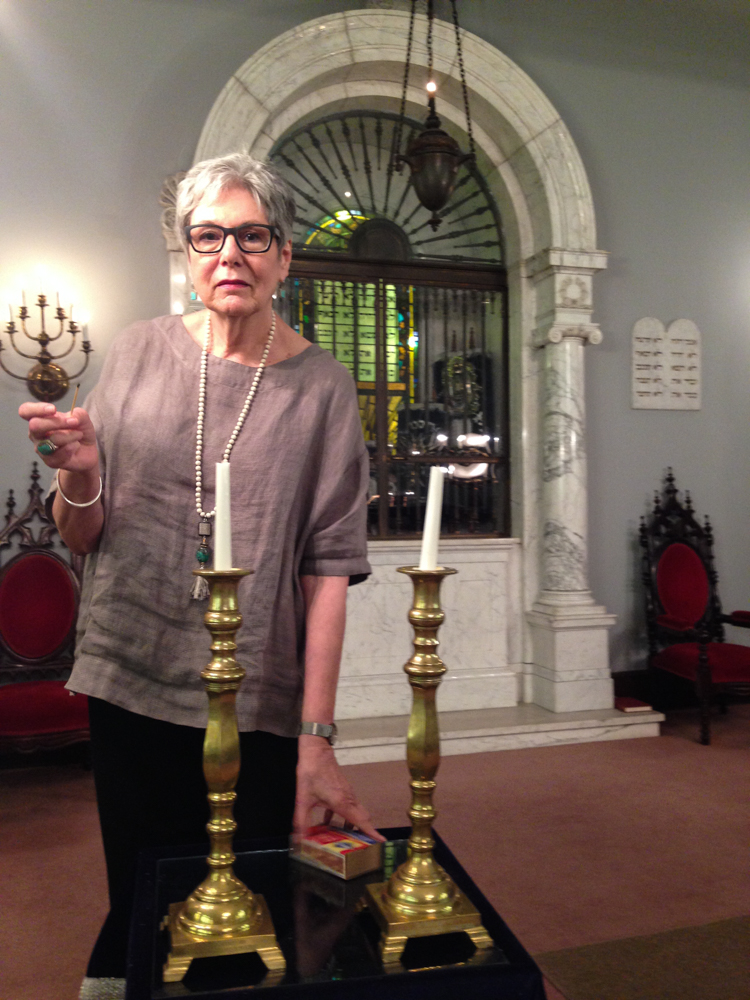
Elise Abrams Rushing lights the candles at Temple B’Nai Israel in Natchez every Friday night because she says she is the last Jewish woman around to do it.
Me and my mother on the bimah of Temple B’Nai Israel in Natchez during the 1994 Natchez Jewish Homecoming.
Dave Diehl’s 8th grade algebra class at Chicago Jesuit Academy.
When it comes to education, how do you teach all the things tests can’t measure?
One Chicago middle school thinks it has the answer. There, life skills and character matter as much as geometry and algebra.
The school is Chicago Jesuit Academy, and I spent a week there reporting in November. The story was edited by WBEZ’s City Desk Editor, Cate Cahan. It originally aired on WBEZ 91.5 FM in February of 2012.
The audio is above. Here’s the print version.
* * *
In education, sometimes it’s the oldest questions that matter most: What makes a good teacher? How does a school get test scores up? But, these days, educators are also asking this question: How important are all the things tests can’t measure?
A middle school on Chicago’s West Side thinks it has an answer. We take you to Chicago Jesuit Academy, a school that teaches—and grades– life skills right up there with book learning.
Eighth grader Brandyn Snow and his mom have this morning routine: As he makes his way to school, he has to call and let her know he’s safe– four different times.
I’m headed towards Lake now,” he tells her, as the 85 bus passes underneath the Green Line. “I’ll call you at Jackson, then when I get on bus, then when I get to school.”
“At first I thought she didn’t trust me,” he says. “But she’s just trying to protect me.”
“What is she protecting you from?” I ask him.
“Well, danger,” he replies. “People trying to hurt other people.”
Like that group of older boys who beat him up in elementary school.
Or those guys who shot and killed those two teenagers waiting for the bus back in October.
People like that.
Brandyn calls his mom a fourth time as the bus lets him off at the corner of Laramie and Jackson, at Chicago Jesuit Academy. Ninety-six 5th through 8th graders go to school here– all boys, mostly from rough West Side neighborhoods like Brandyn’s.
Teaching character in a morning handshake
When Brandyn walks into CJA’s spare but sunny atrium every morning, he sees Dave Diehl, the Dean of Students, standing by the door, holding a clip board.
Brandyn knows the rules: First, take off your jacket. Then, look Mr. Diehl in the eye and shake his hand.
“Good morning Mr. Diehl.”
“Good morning Mr. Snow,” Diehl answers, checking off Brandyn’s name. “Do you have your belt on?”
“Yes.”
“You may head up.”
These rules are an explicit part of the school’s culture. But they’re also triage – a check for any problems the kids might be having.
“Do the students often forget their belts?” I ask Diehl. “I noticed you asking each of them if they have it on.”
“They forget it occasionally,” he tells me. “It’s more of a check for them– it’s an indicator. If they’ve forgotten that they’re forgetting other things.”
Discipline and dress codes aren’t new in education. But here, there’s an additional question: Can you teach middle school kids practical life skills and character– along with math?
High expectations
CJA is expensive: $17,500 per student per year. But kids go here basically for free—most of the tuition is paid by private donors, and the school only takes kids whose families don’t make a lot of money.
Most of the students went to poorly performing elementary schools before they applied to this 7-year-old school, which is part of a loose national network of faith-based schools called NativityMiguel.
CJA administrators insist they don’t “cream the crop” during admissions by taking only boys with good test scores– they say they’ve admitted students who perform as low as the 10th percentile nationally.
But they do look at other things: Parental involvement, for instance, and behaviors that suggest how a boy might cope in a demanding environment. That’s because students are expected to leave here testing above grade level. Last year’s 8th graders tested, on average, at the 11th grade level.
The goal is for them to get into top high schools, with scholarships. Then, for them to compete at those schools, to thrive– alongside more privileged classmates.
Lessons learned
Tom Beckley is the principal at CJA. He’s a former Navy man, who sometimes greets his students like new recruits—with a handshake and a hearty “welcome aboard.”
In his cluttered office, tucked in a corner of the main atrium, Beckley says the school didn’t always emphasize character and behavior the way it does now.
At first, they mainly pushed students academically, trying to make up for time lost in failing elementary schools. That approach seemed to work: Many of their first graduates had strong test scores and got into good high schools – Loyola, St. Ignatius, even East Coast boarding schools.
But then, Beckley says, they did not do well in 9th grade.
“They went to high school and struggled right out of the gate,” he says. “We scratched our heads and said, but look at their test scores! We realized, boy, that’s only a small part of the equation.”
At CJA, students are called by their last names—‘Mr. Snow,’ instead of ‘Brandyn.’ The school tries to treat these kids—as young as 9—like adults. (WBEZ/Robin Amer)CJA stays in touch with all of their graduates, and these days those first grads have settled into their college prep high schools and are doing pretty well. But as freshly minted 9th graders they had bad study habits and made bad choices: Their homework folders were a mess; they always chose gym over study hall. And, they had attitude problems: Beckley says these kids couldn’t control their impulses, and no one could tell them what to do. He says pushing them academically hadn’t been enough.
Beckley says he realized that when you look at grades, it doesn’t say attitude, organizationand math. It just says math. So about a year and a half ago the school put in place a new grading policy, one that took attitude and organization more seriously.
Now at CJA, it’s not enough to master Y=X. Now, 70 percent of every grade a student gets here– on every spelling worksheet, every book report – is based on behavior and habits that CJA calls executive function.
Beckley rattles off some of the expectations involved: “You are doing every single problem of a mathematics assignment regardless of whether or not you have gotten each one wrong. You know how to put down objectives in your notebook and you always have a heading on your paper. You’re always contacting your teacher outside of class at least once in a week.”
“Those are the most important skills they need,” he says. “What we see over and over, is that students with average academic aptitude can really be successful if they have an excellent set of executive function skills.”
So if student is failing at CJA, that doesn’t mean they don’t get the math. They just might not have their act together.
“It’s possible here – theoretically,” Beckley says, “for a student to never get a single math problem or spelling word or vocabulary word correct and still pass with a 70 percent if they have tried their hardest and done every single piece on their rubrics for executive function.”
“But what we know as educators,” he says, “is that while that’s theoretically possible, the student who’s doing all those things – who’s engaged, paying attention, who’s asking for help, who’s talking to their teachers outside the classroom, who’s turning things in on time – that guy learns.”
Not everyone was convinced, at first. Beckley says that when they adopted this new grading policy, even the school’s own teachers were skeptical– “really worried,” he says, about what would happen. Some parents were skeptical, too. Like Brandyn’s mom, Tina Jackson.
“I was like, oh, this is not going be good, because this is too much for a young child,” she says. “Why go through all this? You gotta make sure you have your belt on, your shoes are tied, they have to be a certain color.”
And it was too much for some kids. In the past year and a half, 12 students have been asked to leave the school because of academic or behavior problems. And 8 were withdrawn by their parents, who thought the school was too demanding or who disagreed with their approach.
Experts weigh in
In the classroom that doubles as a lunch room 7th grade math and social studies teacher Matte Durkin rings the lunch bell with three crisp strokes of the gong. The room falls silent as he calls their attention to the white board, where the school has written up the day’s menu.
“Please take three meat balls,” he says. “Make sure you grab some cauliflower and fruit. Get all those on your plates. Please take one piece of bread. And make sure to drink your milk.” At his signal, the students take their seats.
Education researchers don’t argue that behavior and good study habits, like the kind CJA emphasizes, are important. But they say it isn’t clear yet what tactics are best for teaching the kind of behaviors and attitudes that lead to student success.
These points are among the conclusions in a survey the University of Chicago’s Consortium on Chicago School Research will release next month. The study looks at the existing research on non-cognitive assessment –all the stuff tests don’t measure.
They haven’t looked at CJA specifically, because they don’t study private schools. But a lot of schools are trying to teach this stuff. That includes a New York school that gives students separate report cards that measure character. And schools that emphasize what researchers call academic tenacity, or grit: If I fail …do I try again?
But Beckley is convinced CJA’s focusing on the right stuff to help kids transition to high school. He says they have to treat kids – as young as 9 – like grownups, now. It’s why they’re called “Mr. Snow” instead of “Brandyn,” and why they’re held to such high standards.
“One thing I think is very, very unfair,” he says, is “if you’re growing up on the West Side of Chicago, and you want to be able to access a first rate private high school, by end of your 7th grade year that’s a done deal. I know I wasn’t ready for that in 7th grade, and yet, they have to be.”
He says that since they’ve started using their new policies CJA’s teachers have come around. And Brandyn’s mom says the structure has helped her son get his act together.
“I honestly don’t think Brandyn would be in 8th grade,” if it weren’t for the school’s rigor, she says. “I think I’d be dealing with a child that didn’t want to go to school.”
Support: The other side of the equation
One thing researchers say we do know is that especially for middle school kids, two things are critical: clear expectations and a lot of support.
Beckley teaches Formation, a class to help eighth graders deal with the pressure of their young, complicated lives.
“So yesterday I asked for some honesty,” he says, addressing the class from the front of the room.
“I’d argue that all of you have fear or stress about what? Raise your hand if you remember.”
The answer is high school choices. Chicago area high schools send out their acceptance letters starting this week, and the topic is on every 8th grader’s mind.
So this week he’s asked them to think about the very best and very worst things that have ever happened to them– to establish a scale. He wants them to think in this way: If that thing I went through before was worse than this stress now, then I can get through this stress ok.
They’ve started with essays on the worst thing that’s ever happened to them.
“No one has anything to be ashamed of,” Beckley reassures them, and calls the first student to the front of the room.
Some of today’s “worst experience“ stories have happy endings: One boy describes how scared he was the time he accidentally lost track of his 4-year-old brother on the CTA, even though the brother turned up okay.
But other stories belie traumatic experiences: One student describes the day his uncle was killed– stabbed in the neck. Another explains that his mom’s boyfriend is serving a life sentence in prison for murder, after a fight with an upstairs neighbor escalated.
After each essay, Beckley asks the class to evaluate it, according to a three-point scale he’s handed out before class.
“Guys, honesty?” Beckley asks.
The boys cry out in unison: “Three!”
“Is there an exceptionally strong sense of audience and voice?”
“Three!”
Then Beckley calls Brandyn’s cousin Davion up to the front of the room.
He faces the class and begins to read: “When I was four months old my dad got shot and so he’s paralyzed.”
As he continues, his voice begins to waver. “It really pisses me off to know that the man who shot my dad is still walking around somewhere in the world. The man who took that away from me I want to kill him when I get older.”
He begins to cry. “But I don’t want to because I don’t want to go to jail.”
“Davion, you can have a seat,” Beckley tells the boy.
Davion does sit down, but he’s still crying. Brandyn goes over to comfort him.
Then Beckley gets up and stands in front of the class. His head is bent; his lips are pursed– like he’s struggling to figure out what to say.
“I’m proud of you guys…every day,” he says, finally. “Let’s get to work. Go ahead and pack your things.”
Davion is still crying when he walks into the hallway, but adults walk with him to see the school’s social worker. I’m not allowed to follow him into her office, but I see him later that day, and he seems to be okay.
High school persistence
Ten hours after he said good-bye to his mom this morning Brandyn sits behind his drum set for jazz band practice. Today they’re rehearsing the jazz standard “Mood Indigo.”
Brandyn would really like to go to one of Chicago’s arts high schools. He’s auditioned for two. He’s also taken the entrance exams for Loyola and for selective enrollment public schools like Whitney Young. His mom, Tina Jackson, says his motivation makes her proud.
“In the beginning he just wanted to graduate,” she says. “Now he wants to go to college and knows which one and how much it costs.”
But she says she also knows how hard it will be for Brandyn to be on that path – and how hard it will be for him to stay there.
Recording on the deck of Excalibur. Photo by Karen Hoffman.
6:20
At the start of the Race to Mackinac I was several miles out from the shoreline, photographing competitors from the press boat. Occasionally a missive would come across the radio from the race committee.
“Argo this is Breaker, we see 19 boats.”
“Copy that Argo, we also see 19 boats.”
Once all the starters from that category had been accounted for, the race committee would sound the starting cannon and they would be off, colorful spinnakers raised to the wind. The next line of boats would advance from the starting area.
But occasionally a boat would not be accounted for, and the race committee would radio back and forth trying to find them. In the middle of the afternoon we heard this on the radio:
“Where’s WingNuts?”
If you’ve been following the news or heard my recent story on the subject, you probably know that WingNuts is a 35 ft. sailboat out of Saginaw, Mich., that would tragically and shockingly lose its skipper another crewmember before the weekend was out.
The Chicago Yacht Club’s Dockmaster, Ryan McPheeters, who was driving the press boat, smiled and shook his head when he heard the race committee was looking for WingNuts. “That boat is wacky,” he told me.
“What do you mean?”
He reiterated. “That boat is wacky and her crew is wacky.”
He pointed out the sides of the hull that swooped out at the deck to make what looked like wings. This was apparently somewhat unusual. I got the impression from the rest of the conversation that when he called the crew wacky he meant they were fun loving and well-liked.
When I came into work Monday morning, preparing to finish what was supposed to be a light-hearted multimedia story about the race, and heard that two competitors had died, I was really stunned.
I remember walking over to my co-worker’s desk in a daze.
“They were from Wingnuts…?”
I couldn’t believe that people had died. I couldn’t believe I had seen them. I was worried for the other people I knew in the race, and I knew I couldn’t complete the story I had originally intended to produce.
Going through my tape was like listening for ghosts. I found moments I had forgotten about: the crew of Excalibur reading their Sail Flow charts and pointing out a storm that was likely to hit at 1 a.m. Sunday night; running into Sociable on our way to the start and hearing their crew joke around with Excalibur’s about how they were heading the wrong way, as they went to drop me off at Monroe Harbor.
It was very eerie.
Since I’ve finished the story I’ve gotten some interesting feedback from people in the sailing community. In my reporting, I heard people raise questions about the role of the Coast Guard in the search and rescue operation. Later I heard from a sailor who is also part of the Beneteau fleet that counts both Sociable and Excalibur in its ranks. “Spending the night monitoring the VHF transmissions from Sociable was one of the worst experiences of my life,” he told me. He also said this:
“I don’t know if the expectation of rescue is something more concentrated on the [Great] Lakes or if it comes from inexperience, but I started hearing that around from some sailors who were newer to the sport and none had left the [Great] Lakes. On the Pacific, on shorter races than the Mac, we are regularly out of rescue range for days on end…
Anyhow, the lack of divers certainly didn’t make any difference in the outcome. No chopper could have launched in that storm and it would still take 45 min. to an hour to reach them. After that long unconscious and under water, a diver can’t help anyway. It’s still terrible, but there is no reason to blame lack of rescue. Only to praise the efforts of Sociable and the others who responded.”
This came from a WBEZ listener who heard the story when it aired on 848:
“The USCGC Mackinaw does indeed follow the race, but is there as a courtesy escort. The thought of one boat being expected to ensure the safety of over 300 boats, of different speeds, scattered throughout the lake, is ridiculous, and it’s disturbing to hear that a sailor expected this. Sailing is a challenging sport, and most boaters realize that the responsibility for the their safety ultimately lies in their own hands.
Counting on the Coast Guard to behave like a safety net is a dangerous attitude to bring on the water. Sailing on our Great Lakes is an incredibly rewarding pastime, but the challenges that make it so come with risks that we sailors must accept and take responsibility for.”
I plan to stay on this story, although I don’t relish the next step: talking to the Charlevoix County Sheriff’s office when they get back the coroner’s report some time in the next few weeks.
Rising Sun Mills, located down the street from Chris Freed’s building, was rehabed and converted into condos. At the time it was purchased for renovation, there were still several small businesses and artists with spaces in the complex.
During the housing boom earlier this decade, developers began scooping up abandoned or underused factory buildings to convert them into condos. But as I examined in this piece for the public radio show Marketplace, this trend may have been bad for business.
This piece originally aired on Marketplace on February 16, 2005.
You can listen to the piece on Marketplace’s website here.
This piece originally aired on the public radio program Marketplace on April 6, 2005. You can hear the piece on their websitehere.
Whatever the face value of the money in your wallet, chances are good it’ll be worth less – eventually. That’s what inflation tends to do to cold hard cash. One could invest in art, for example, but you’d have to part with your cash. Or would you? Robin Amer reports.
Visit the Noney website here, and Providence artist Alec Thibodeau’s other work here.
This episode of Inside Out originally aired in the fall of 2001.
Anna Goldman explains why, as a child, the way to her heart was through her stomach.
Jess Jones visits Geno’s Steaks in her beloved home town of Philadelphia to figure out what makes a genuine Philly cheese steak beat out all the imitators.
In a piece that Ira Glass once described as part musical theater, Gabriel Wildau muses on “the Ratty,” Brown’s dining hall, and their industrial sized vats of pasta sauce.
Robin Amer recreates a passage from Truman Capote’s short story, A Christmas Memory. Read by Seth Pipkin.
Hosted by Molly Messick with Executive Producer Robin Amer. Contributors include Rebecca Birnbaum, Louisa Lombard, Megan Hall, Selena Juneau-Vogel, Jess Jones, and Paul McCarthy. Oversight by Beth Taylor.
Editor’s Note: I have no idea where I came across that Capote story, or why I produced it for this show. Out of all the stories about food, why this? Especially when I could have chosen something more contemporary and er, meaty, like David Foster Wallace’s famous essay on the strange brutality of eating lobster. This Capote story seems so antiquated and arcane to me now, with its racist depictions of the village “Indian” they go to for rum, and its quaint phrasing like, “Anyone t’ home?”
This episode of Inside Out originally aired in the fall of 2001.
In this episode about our national pastime:
Louisa Lombard interviews her cousin, a top prospect for the Atlanta Braves, about the chutes and ladders of the minor leagues.
Rachel Katzman investigates the Slaterettes – the country’s only all-girl little league.
Samm Tyroller-Cooper asks why members of the Providence Grays (pictured above) want to play baseball like it’s 1879.
Hosted by Molly Messick with Executive Producer Robin Amer. Contributors include Megan Hall, Selena Juneau-Vogel, Doug Fretty, Rachel Terp, Matt Puntigam, and Gabriel Wildau. Oversight by Beth Taylor.
This episode of Inside Out originally aired in the spring of 2001.
In this episode of Inside Out exploring the very human fascination with death, Anna Goldman and I reported on a laboratory promising to revive you after death, by freezing you in life. (We were so on the cryonics story before the whole Ted Williams thing.)
You’ll also hear stories about ritual Jewish burial preparation, a gorgeous portrait of a funeral home director produced before HBO’s Six Feet Under explored the same way of life, and an excerpt from Tim O’Brien’s classic Vietnam War novel, The Things They Carried.
Hosted by Nathan James. Executive Produced by Paul McCarthy with original music by Chris Bell. Contributors include Cassie Tharinger, Elana Berkowitz, Leanne Hegg, Danielle Posen, Molly Messick, Anna Goldman, Robin Amer, and Chris Muller. Oversight by Beth Taylor.







 Robin Amer
You must be logged in to post a comment.